
Coherent Causal Theory 2
Part 2 - The Concept: Why Managers Love a Story That Makes Sense
Coherent Causal Theory: Why Managers Gravitate Toward Stories That Feel Right, Not Stories That Are True
When Daniel Kahneman talks about Coherent Causal Theory, he highlights a powerful cognitive tendency:
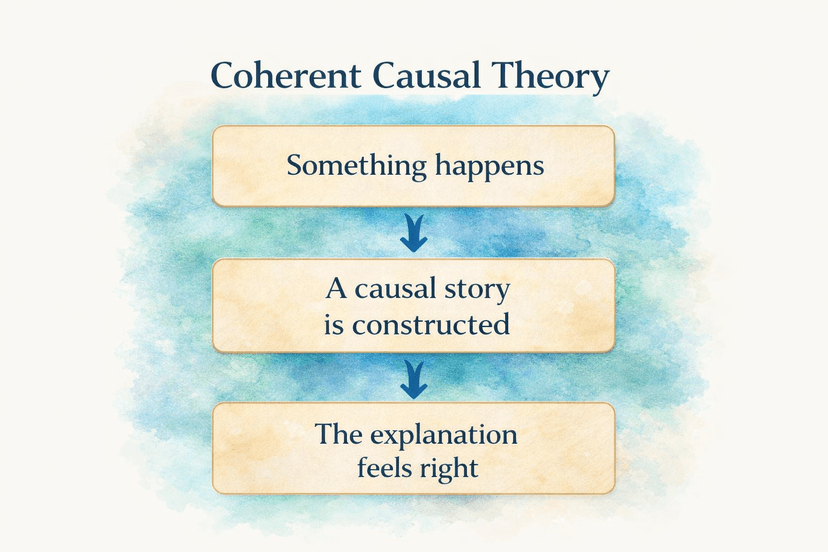
We prefer explanations that form a clean, internally consistent story - even when the explanation is incomplete or incorrect.
This preference is especially strong in management, where daily ambiguity creates pressure to make sense of events quickly.
1. What Coherent Causal Theory Actually Means
Humans are uncomfortable with randomness. We want events to be linked by understandable mechanisms. So when something goes wrong, poor output, a sudden resignation, a late shipment; our minds immediately start assembling a tidy narrative, one where:
- each piece leads logically to the next,
- the story has a beginning, middle, and end,
- nothing is left unexplained,
- and the conclusion feels inevitable.
Kahneman's point is simple:
Coherence matters more to people than accuracy.
This explains why teams latch onto explanations like:
- "Morale is low."
- "People don't care."
- "We need more discipline."
- "It's because of the new ERP system."
These explanations are rarely complete, but they are psychologically comfortable, because they are coherent.
2. The Manager's Trap: Coherence Over Truth
Managers face this tension every day. Claire (from Part 1) had: limited information, a performance issue to explain, a full diary and pressure to give answers.
"Morale issues" ticked every box:
It explained all symptoms at once. It felt intuitive. It created a sense of order and inevitability. It required no immediate further investigation.
The alternative was harder:
- "I don't know yet."
- "There may be multiple causes."
- "We need to gather evidence first."
Teams dislike ambiguity. Executives dislike it even more. So coherent stories win.
3. Why Coherent Causal Stories Feel So Compelling
Three forces are at work:
a) Narrative Compactness - A single-cause explanation feels elegant. "Morale" tied everything together in one stroke. Real systems? Messy, multi-factor, interacting; but compact stories feel "smart."
b) Emotional Symmetry - We subconsciously match the scale of the explanation to the scale of the outcome. A huge performance drop "deserves" a big explanation. A jammed regulator feels too small, emotionally inconsistent, so it gets ignored.
c) Predictive Comfort - Coherent stories restore a sense of control. If morale caused the drop, then improving morale fixes it. But if a random mechanical failure caused it? That's uncomfortable. So we downplay randomness to regain psychological safety.
4. The Leadership Opportunity: Using Coherence Responsibly
We can't eliminate our preference for coherent stories. But we can use it consciously.
a) When analysing problems: fight coherence with curiosity
Five practical habits:
1. Name the story, you're telling yourself.
2. Generate alternatives, aim for at least 3 hypotheses.
3. Separate facts from assumptions.
4. Check for scale mismatch (big explanation + small evidence? red flag).
5. Break the problem into contributing factors.
This slows the mind just enough to see what's actually happening.
b) When leading people: craft coherent stories that empower, not blame
People crave clarity. Leaders should use coherent narratives to: explain change, clarify priorities, align actions with strategy, create meaning.
But responsibly:
- Base the story on evidence,
- Be transparent about uncertainty,
- Acknowledge multi-polar causes,
- Avoid person-focused blame narratives.
The goal: coherence that strengthens learning, not convenience.
5. Manager's Checklist: Coherent Causal Leadership
A short decision-making rubric:
- Am I choosing this explanation because it feels tidy or because it is true?
- Have I considered both technical and behavioural causes?
- Am I being pulled into a single-cause narrative? Why?
- Does the scale of the explanation match the scale of the data---not just the emotion?
- Have I communicated what we don't yet know?
- Does this story drive learning, or blame?
When leaders do this consistently, teams become more analytical, less reactive, and more willing to challenge easy narratives.
Coherent causal theory doesn't mean leaders are irrational, it means they're human. In an uncertain world, tidy stories give us comfort.
But leadership requires that we pause before accepting the explanation that simply feels right.
Often, the truth is messier. But it's also more useful.
Great managers don't eliminate coherence, they harness it. They build narratives that are evidence-based, nuanced, and empowering.
And once you learn to spot your own love of tidy stories, you begin to see the difference between: "the story that feels right" and "the explanation that is true enough to act on." That difference is the foundation of better decisions, better teams, and better operations.